
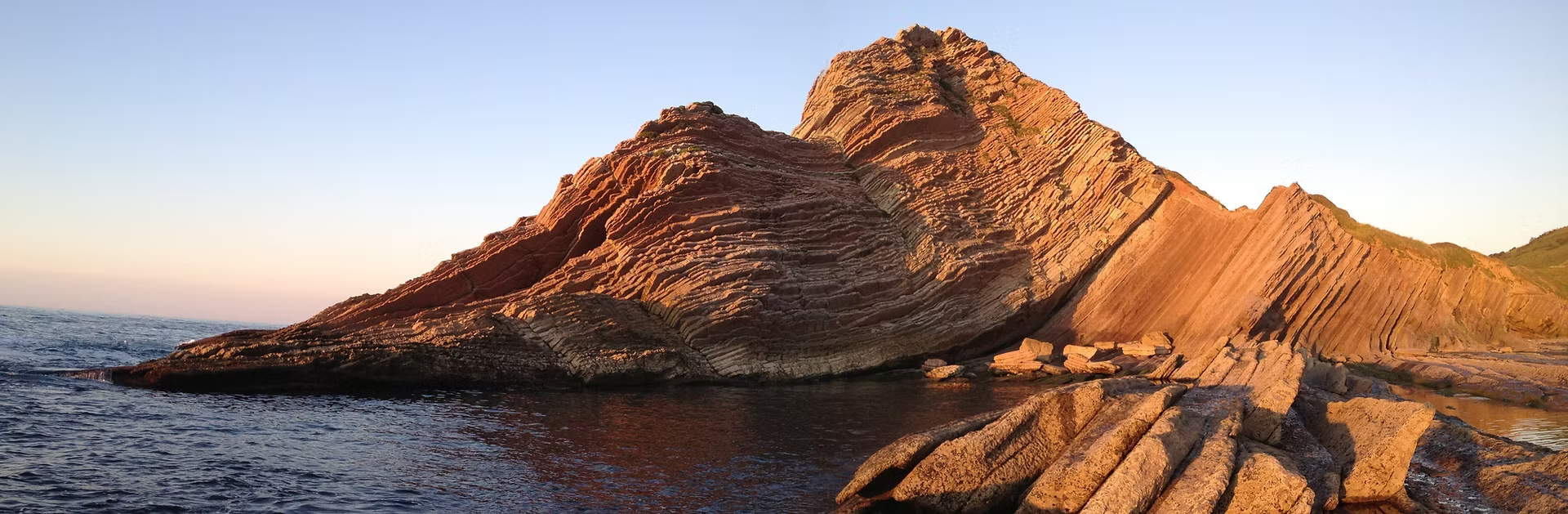
© CC BY-NC-SA Irene Elorza Guereño
EKGeoparkea Asier Hilario
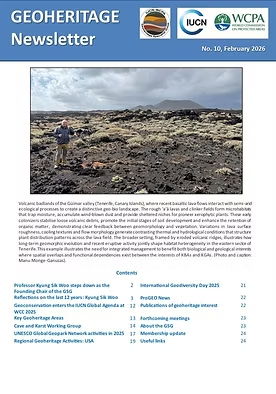
Discover the latest insights on geoheritage conservation and global initiatives in the IUCN WCPA Geoheritage Specialist Group Newsletter. This issue highlights key projects, case studies, and developments from around the world. Read the full newsletter and stay connected with the geoheritage community at progeo.ngo
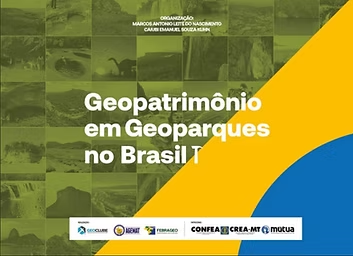
This publication contains the rich diversity of Brazil’s geological heritage through contributions from more than 60 experts. The volume presents the most significant geosites within Brazil’s UNESCO Global Geoparks, as well as other nationally important sites, highlighting their scientific, educational, and geotouristic value. This work offers accessible, high-quality information aimed at strengthening the appreciation, protection, and sustainable use of these unique landscapes. A landmark reference for geoscientists, geopark professionals, and all those interested in Brazil’s natural heritage.
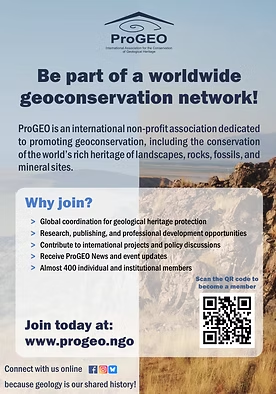
Promotional leaflet introducing the mission, activities, and benefits of joining ProGEO — the International Association for the Conservation of Geological Heritage.
This downloadable flyer is designed for easy sharing at conferences, workshops, university events, and field activities
Feel free to print and distribute it to help promote ProGEO and strengthen the global geoconservation community!
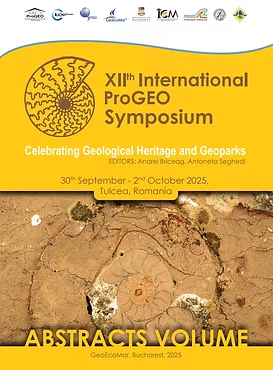
The publication gathers the full collection of research abstracts presented during the 2025 symposium held in Tulcea, Romania. The volume showcases current advances in geoheritage research, conservation, geosite management, and geodiversity assessment from across Europe and beyond. Hosted in the unique geological and cultural setting of the Danube Delta, the symposium brought together scientists, practitioners, and policy-makers to discuss emerging challenges and future directions in geoheritage protection.
The following publications were edited by the International Union of Geological Sciences (IUGS) in 2022.
They represent essential global references for geoheritage and geodiversity assessment, and are listed here as key resources aligning with PROGEO’s mission.
This document is official IUGS publications and is shared here with full attribution to support awareness of globally significant geoheritage resources.
The following publications were edited by the International Union of Geological Sciences (IUGS) in 2024.
They represent essential global references for geoheritage and geodiversity assessment, and are listed here as key resources aligning with PROGEO’s mission.
This document is official IUGS publications and is shared here with full attribution to support awareness of globally significant geoheritage resources.
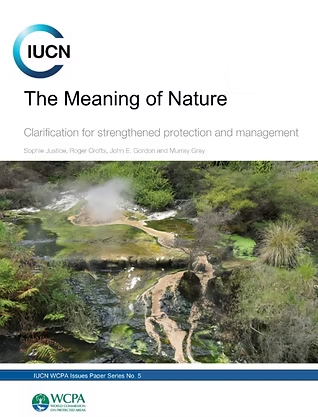
What do we really mean when we talk about nature? The word appears everywhere in policy documents, conservation strategies, economic frameworks, and global agreements, yet its meaning is often assumed rather than examined. For decades, international environmental efforts have focused principally on biodiversity, unintentionally narrowing the scope of what we strive to protect. But nature is far more than the living world alone. It is also the soils, rocks, water, landforms and physical processes that shape our planet and sustain life in all its forms.
Justice et al., 2025. IUCN WCPA Issues Paper Series No. 5
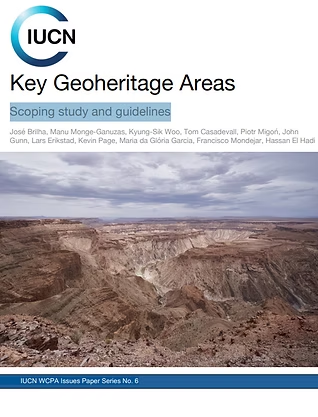
The publication introduces an ambitious global framework for identifying the Earth’s most exceptional geological sites — the Key Geoheritage Areas (KGA). It presents a visionary approach to geoconservation, positioning KGAs as the geological counterpart to Key Biodiversity Areas. The document sets out clear criteria for recognising landscapes, rock formations, fossils, and geomorphological features that reveal crucial chapters of Earth’s history.
Brilha et al. 2025, IUCN WCPA Issues Paper Series No. 6
The Field Trip Guidebook offers a concise yet comprehensive overview of the key geosites of southern Poland, focusing on the Kraków Region, the Ojców Plateau, the Nida Gypsum Basin and selected areas of the Holy Cross Mountains. Prepared by leading specialists, the volume integrates geological context with detailed field observations, providing a valuable synthesis of stratigraphy, sedimentology, karst development and geoheritage. The guidebook presents the geological framework of the Kraków area, highlighting the interplay of Mesozoic, Neogene and Quaternary processes. Classic stops such as the Bochnia Salt Mine, Bonarka, Wawel Hill and the Kraków Gate in Ojców illustrate how lithology, tectonics and landscape evolution intersect. A central section focuses on the unique Badenian gypsum deposits of the Ponidzie Region, including Chotel Czerwony, Skorocice and Siesławice—globally significant sites for studying giant selenite, sabre gypsum and evaporite karst. The post-symposium part covers the Holy Cross Mountains, presenting core Paleozoic sequences and the epi-Variscan unconformity, which provide essential reference points for Central European geology.
Overall, the guidebook serves as a scientifically rigorous and well-illustrated resource for field teaching and research, offering a compact yet authoritative summary of the region’s most important geological features.
The publication gathers the full collection of research abstracts presented during the 2018 symposium held in Chęciny, Poland. It reflects the diversity and breadth of contemporary research in geoheritage, geoconservation and landscape management, showcasing contributions from leading scientists, policy makers and practitioners from around the world.
The volume includes keynote lectures, thematic sessions and poster presentations covering topics such as geodiversity assessment, geosite management, geotourism, links between geological and cultural heritage, innovative documentation techniques (including LiDAR, TLS and 3D modelling), community engagement, and best practices from geoparks and protected areas worldwide. With its comprehensive programme ranging from conceptual frameworks to detailed case studies across Europe, Asia, Africa and the Americas, the book serves as a valuable reference for researchers, students and professionals involved in the protection, interpretation and sustainable use of geological heritage.
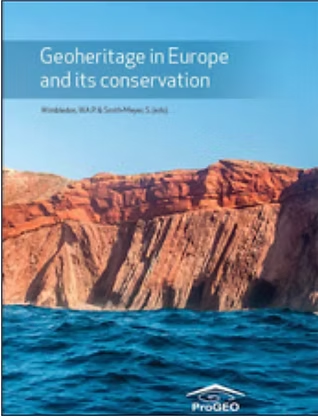
ProGEO’s book (hard-cover volume)
Geoheritage in Europe and its conservation.
Wimbledon, W.A.P. & Smith-Meyer, S. (eds) 2012. 405 pages.
ISBN: 978-82-426-2476-5
This is the first serious peer-reviewed journal ever that has been dedicated to geoheritage (site and portable), geoconservation, interpretation and geotourism. Geoheritage is an international journal dedicated to discussing all aspects of our global geoheritage, both in situ and portable. The journal will invite all contributions on the conservation of sites and materials – use, protection and practical heritage management – as well as its interpretation through education, training and tourism.
We kindly encourage you to submit your work!
Publisher – Springer Berlin Heidelberg
Please read further information on:
http://link.springer.com/journal/12371
Geodiversity, Geoheritage & Geoconservation
the ProGEO simple guide (English)
Geodiversidad, Patrimonio Geológico & Geoconservación
Géodiversité, Géopatrimoine & Géoconservation
NEWS